Join Our Community










Get the earliest access to hand-picked content weekly for free.
Spam-free guaranteed! Only insights.
Join Our Community
Get the earliest access to hand-picked content weekly for free.
Spam-free guaranteed! Only insights.
🎯 Quick Impact Summary
* Open Source Freedom: Protenix-v1 is released under the Apache 2.0 license, allowing unrestricted commercial and academic use, unlike AlphaFold3.
* AF3-Level Accuracy: The model achieves performance comparable to AlphaFold3 on protein-ligand and biomolecular complex prediction benchmarks.
* Cost Efficiency: While the software is free, users must invest in high-end GPU hardware or cloud credits for inference.
* Versatile Applications: Ideal for drug discovery, protein engineering, and structural biology research involving DNA/RNA and small molecules.
* Emerging Tool: While powerful, it has a less mature support community than AlphaFold2, requiring users to have some technical expertise in computational biology.
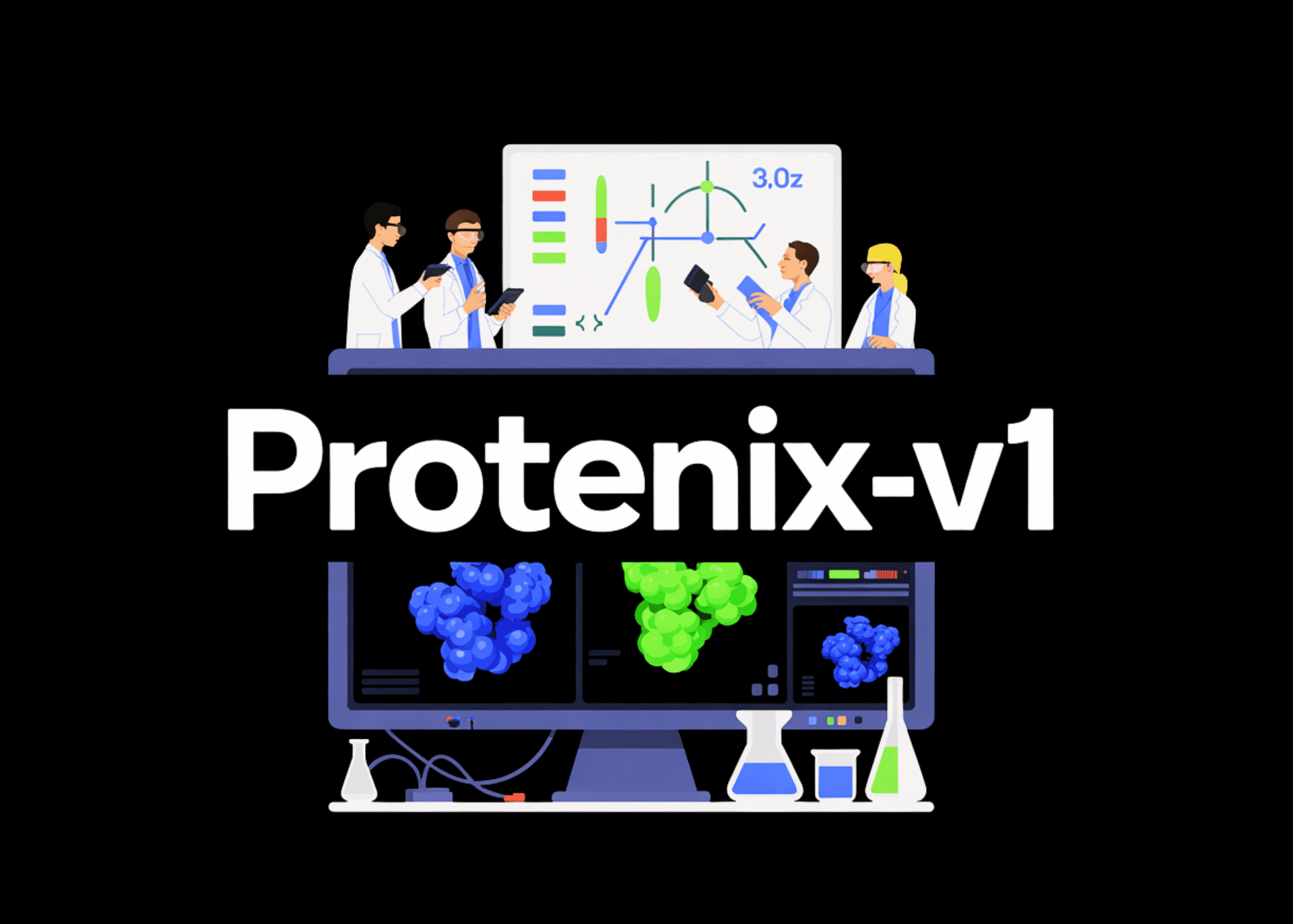
ByteDance has made a significant entry into the computational biology space with the release of Protenix-v1, an open-source AI model designed to predict biomolecular structures with accuracy rivaling Google DeepMind’s AlphaFold3 (AF3). This tool addresses the critical challenge of drug discovery by enabling researchers to visualize how proteins, DNA, RNA, and small molecule ligands interact, a capability that has historically been gated behind proprietary, closed-source systems. Designed for academic researchers, biotech startups, and pharmaceutical companies, Protenix-v1 offers a cost-effective alternative for high-fidelity structural biology without the licensing restrictions of commercial competitors.
Protenix-v1 stands out due to its impressive versatility and performance metrics. Unlike earlier open-source models that focused primarily on protein monomers, Protenix handles complex biomolecular systems.
* Comprehensive Molecular Support: The model can predict structures involving proteins, nucleic acids (DNA/RNA), and small molecule ligands simultaneously. This is crucial for understanding drug-target interactions and gene regulation mechanisms. * High Accuracy: ByteDance reports that Protenix achieves performance levels comparable to AlphaFold3 on standard benchmarks like the PoseBusters dataset. It demonstrates high success rates in predicting binding poses of drug-like molecules, which is vital for virtual screening in drug discovery. * Open Source Accessibility: Unlike AlphaFold3, which requires a non-commercial license request or paid access for commercial use, Protenix-v1 is released under the Apache 2.0 license. This allows for unrestricted commercial usage, modification, and distribution. * Inference Pipeline: The model utilizes a diffusion-based architecture, similar to AlphaFold3, but optimized for stability and speed. It includes a pre-trained weights release, allowing users to bypass the computationally expensive training phase.
Protenix-v1 utilizes a transformer-based architecture combined with a diffusion network. The process begins with the tokenization of input sequences (amino acids, nucleotides) and their associated chemical structures.
1. Input Processing: The model takes Multiple Sequence Alignments (MSAs) and ligand representations as input. 2. Structure Embedding: It uses a 3D equivariant transformer to process pairwise interactions, iteratively refining the spatial coordinates of atoms. 3. Diffusion Refinement: A diffusion model is applied to denoise the initial structure predictions, allowing for high-precision modeling of flexible regions and binding pockets. 4. Output: The final output is a 3D coordinate file (PDB format) representing the lowest energy state of the complex.
The training data largely mirrors that of AlphaFold3, utilizing the PDB (Protein Data Bank) and large-scale synthetic datasets, but ByteDance has introduced specific data augmentation techniques to improve ligand docking accuracy.
Protenix-v1 is immediately applicable in several high-impact domains:
* Drug Discovery: Pharmaceutical researchers can use Protenix to predict how a potential drug molecule binds to a target protein. For example, visualizing the interaction between a kinase inhibitor and a cancer-related enzyme allows for structure-based drug design (SBDD), reducing the need for expensive X-ray crystallography in early stages. * Protein Design: Biotech startups can utilize the model to design novel enzymes or therapeutic proteins by predicting how mutations will affect the 3D structure and function. * Agricultural Biotechnology: The model can be used to engineer proteins for crop protection or improved nutritional profiles by simulating interactions with biological targets in pests or metabolic pathways. * Academic Research: Universities can integrate Protenix into bioinformatics curricula or use it for non-commercial research without the administrative hurdles of requesting access to proprietary models.
As an open-source project, Protenix-v1 is free to use. However, users must account for the computational costs required to run inference.
* Software Cost: $0 (Apache 2.0 License). * Hardware Requirements: Inference requires a GPU with at least 16GB of VRAM (ideally NVIDIA A100 or H100 for batch processing). * Cloud Costs: Running on cloud platforms like AWS or Azure will incur standard compute rates. For a single structure prediction, costs are negligible (cents), but large-scale screening will require significant budget allocation for GPU instances.
Pros: * No Licensing Barriers: Fully open source for commercial applications. * Competitive Performance: Matches or comes very close to AlphaFold3 accuracy on standard benchmarks. * Versatility: Handles protein-ligand, protein-protein, and protein-nucleic acid complexes.
Cons: * Hardware Intensive: Requires high-end GPUs for efficient inference, which may be a barrier for smaller labs. * New Ecosystem: Lacks the mature ecosystem of plugins and wrappers that AlphaFold2/3 have accumulated over years. * Documentation: As a newer release, community support and troubleshooting guides are still growing compared to established tools.
Who Should Use It? * Biotech Startups: Needing to perform high-throughput virtual screening without paying licensing fees. * Academic Researchers: Requiring an open-source tool for structural biology research. * Pharmaceutical R&D: Looking for an alternative to AlphaFold3 for internal validation or to avoid vendor lock-in.
FAQ
Related Topics
AI Spotlights
Unleashing Today's trailblazer, this week's game-changers, and this month's legends in AI. Dive in and discover tools that matter.
OpenAI Codex Chrome Extension Review

Perplexity Personal Computer: AI Agents for Mac

OpenAI Voice Intelligence API: New Features Review

ChatGPT Trusted Contact: New Self-Harm Safeguard
CopilotKit Intelligence: Enterprise AI Memory Platform
OpenAI Training Spec: GPU Performance Breakthrough
AWS Managed Agents Review: OpenAI Partnership

Glean AI Search Review: Enterprise Search Redefined

ChatGPT Security Update: Advanced Protection Features

Mistral's Cloud Code Platform Review
Meta Autodata: AI Framework for Autonomous Data Scientists

Gemini API Webhooks: Real-Time AI Automation
Zyphra TSP: 2.6x Faster AI Training Review

SoundHound OASYS: Self-Learning AI Agent Platform

Google Home Gemini 3.1: Smarter AI Assistant
Grok Voice Think Fast 1.0 Review: AI Voice
Vision Banana Review: Google's Instruction-Tuned Image Generator
GitNexus Review: Open-Source Code Knowledge Graph
Qwen3.6-27B Review: Dense Model Outperforms 397B MoE

ChatGPT Workspace Agents: Custom AI Bots for Teams
You Might Like These Latest News
All AI NewsStay informed with the latest AI news, breakthroughs, trends, and updates shaping the future of artificial intelligence.
AI Data Centers Face Growing Crisis
May 10, 2026
SpaceX Plans $55B AI Chip Plant in Texas
May 8, 2026
Voi Founders Launch AI Startup Pit With $16M Seed
May 8, 2026
US Energy Secretary and NVIDIA Discuss AI-Powered Energy Future
May 8, 2026
Anthropic Finance Agents Disrupt Wall Street Jobs
May 7, 2026
Snap Ends $400M Perplexity AI Search Deal
May 7, 2026
Microsoft Copilot Hits 20M Paid Users
May 6, 2026
Runway Eyes World Models Beyond AI Video
May 6, 2026
Microsoft to Exploit New OpenAI Deal
May 6, 2026

Discover the top AI tools handpicked daily by our editors to help you stay ahead with the latest and most innovative solutions.